Summary
The Goodness Paradox by Richard Wrangham wrestles with the question of why, in some ways, humans seem to be remarkably friendly in the scheme of the animal kingdom, while in other ways, humans are capable of exhibiting terrible, sometimes systematic violence.
Wrangham answers the question by differentiating two types of aggression, "reactive aggression" and "proactive aggression." Reactive aggression is characterized by violent lashing out in response to a provoking stimulus that induces a stress response. Proactive aggression is characterized by forethought and planning of violence and is typically undertaken when the violence is "cost-free" or when there is an extreme likelihood of success. Wrangham asserts that humans have evolved to exhibit very low reactive aggression, which is what allows for our cooperativeness and friendliness. But we did not evolve to exhibit very low proactive aggression, and, in fact, our proactive aggression may have been evolutionarily necessary for causing our lower propensity for reactive aggression.
He spends the early part of the book making a strong case that these two types of aggression are really different things. This was the most neurosciency part of the book. Neurobiologically, the two types of aggression share some similarities, in that people who exhibit higher levels of either type of aggression usually have higher than average activity in limbic brain regions. However, in animal studies, different kinds of violence seem to involve distinct populations of neurons in the hypothalamus and periaqueductal gray. Cats exhibit "proactive aggression" mainly in terms of a hunting and feeding behavior, and there is strong bidirectional inhibition between regions in the hypothalamus responsible for this behavior and those responsible for reactive aggression. In contrast, rats will engage in proactive aggression against members of their own species, characterized by stalking and violent attacks. This proactive aggression is also supported by the same regions as cats, but in rats there is much less inhibition. Wrangham's interpretation is that proactive aggression against members of one's own species arise through coopted hunting behaviors, and this explains why herbivores are observed exhibiting reactive aggression but not proactive aggression.
After convincing us that these two types of aggression are really different, and that humans have significantly less reactive aggression than most animals, Wrangham begins to describe his hypothesis for why this is the case. His hypothesis is that humans are a domesticated species, and that we must have domesticated ourselves.
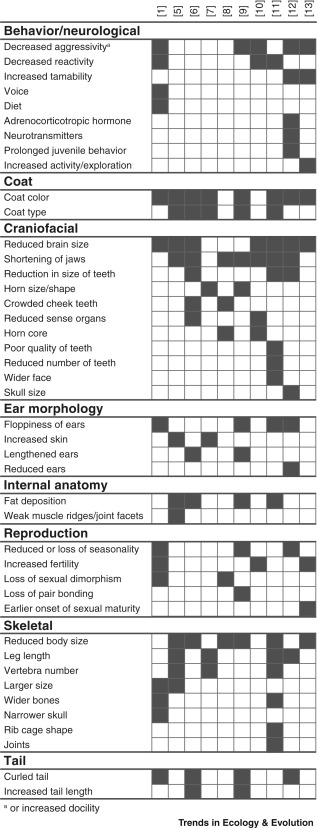
One of the major pieces of evidence in favor of this "self-domestication" hypothesis is that we have several traits that are part of what Wrangham calls the "domestication syndrome," compared to our other relatives in the genus Homo. These are seemingly unrelated traits that often co-occur in species that are bred for tameness, which include being smaller, having floppy ears, having variations to coat color, a smaller brain, and a shorter muzzle, and retaining behavioral characteristics more similar to a child. He also discusses the experiments of Dmitry Belyaev's domestication of silver foxes in the USSR. Wrangham proposes that these changes are due to pleitropic changes in neural crest cell regulating genes, which are required for increased tameness.
To make an argument for the process of self-domestication, Wrangham looks, in part, to the example of bonobos, which also seem to be self-domesticated to some degree and represent an interesting comparison to the very aggressive chimps, since these two species are our closest existing animal relatives. He also brings up examples of islands, where species tend to show traits involved in the domestication syndrome.
In the case of islands and bonobos, geographic features likely led to lower competition and predation, which allowed for self-domestication to occur. But in humans, Wrangham proposes that our ability to form egalitarian male coalitions led to self-domestication through executions of domineering males. He mainly brings in examples from extant hunter-gatherer people to support this idea, as well as the universality of capital punishment in human society, and he suggests that this ability to plan collectively must have depended on the development of language.
This execution hypothesis also offers an explanation for aspects of human morality, particularly around the importance of social standing and obeying social norms. The development of emotions like shame, embarrassment, guilt, and the pain of social isolation may have developed in response to selective pressure due to execution of antisocial members. This would help explain why the intensity of some of these emotions and stress associated with social interactions seems so out of proportion to the actual danger that we face in modern times.
Discussion Questions
Richard Wrangham was the mentor of one of the authors of our previous book, Brian Hare, so the book is highly related to the last one and a lot of the same data informs both their thinking. What did you think of this book compared to the book of last month, Survival of the Friendliest.
Is the only possible explanation for domestication syndrome related to selection for less reactive aggression? For example, could you select for white stars on the head, and it have an effect on reactive aggression (or the playfulness needed for creativity)?
I was surprised at how convinced Richard Wrangham was about the inevitability of patriarchal cultures, which seems tied into the "the execution hypothesis" by male coalitions as the driving force of selection. I've heard other theories around self-domestication - particularly that sexual selection by females of less aggressive men would also have the same affect. Does the narrative around societies dominated by coalitions of males sound right to you based on Wrangham's arguments?
Wrangham proposes that the neural crest cell behavior may be modified by domestication, which then leads to the combined traits that are common across so many domesticated species. But the neural crest cells are involved in many different developmental features, so it seems to me like alterations to neural crest cell regulation will be apparent in all species undergoing rapid change any features that develop from neural crest cells (like the whole cranium). How can we know if selecting for tameness really "causes" the other traits through neural crest cell regulation if the "other traits" are so often different. Here is a chart from a paper by Kathryn Lord et al. (2019) looking at the set of traits that define domestication syndrome in the available papers on the topic. She makes the argument that there is not really a consistent set of traits that defines the syndrome.
If we could easily control aggression (and only aggression) in society, such as through a mandatory pharmaceutical, should we do it?
What did you think of the way that the legal system differentiates between proactive and reactive aggression? What would be a good threshold to differentiate the two legally? Do you agree that proactive aggression should be considered worse than reactive aggression, and why? I thought it was interesting that our society is so shaped by proactive aggression - but that we also have a strong intuitive sense that proactive aggression is only justified in cases where we have the consent of our in-group. It's not something that we are allowed to undertake alone.